Measurement Guide
How to Measure Your Waist
A waist measurement is taken at the narrowest point of your torso, usually 1–2 inches above your belly button. It is used for body shape calculations, pants and jeans sizing, belt size, dress size, waist-to-hip ratio, and body fat estimates. This step by step guide shows exactly where to measure your waist and how to do it correctly at home — for men and women, in inches or centimeters.
Waist Measurement
Measured at the narrowest part of your midsection — usually 1–2 inches above the belly button.
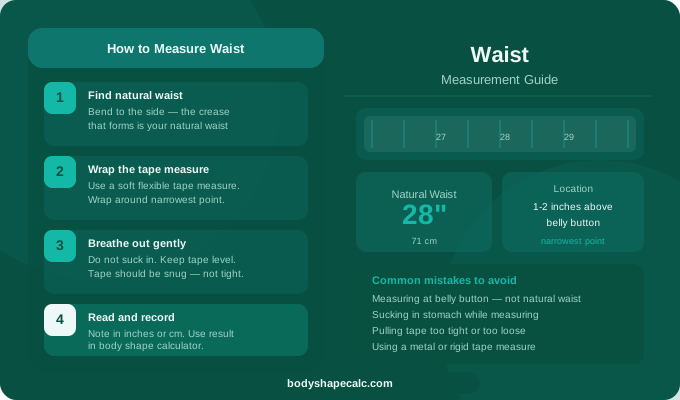
Natural Waist
Where Is the Natural Waist? Waist Measurement Explained
Many people confuse their natural waist with their jean waistband or belly button. Your natural waist is the narrowest part of your torso — usually 1–2 inches above your belly button and well above your hip bones.
How to Find Your Natural Waist
Stand upright and bend slightly to one side. The crease or fold that forms in your midsection is your natural waist. It is the narrowest point of your torso — usually about 1–2 inches above your belly button. If you are unsure, run your fingers up from your hip bones — your natural waist is the narrowest point you reach before the ribcage begins.
Natural Waist vs Belly Button vs Jeans Waist
Your natural waist, belly button, and jean waistband are all at different heights. Your natural waist is the narrowest point — usually above the belly button. Your jean waistband sits lower on the hips. For body shape calculations and dress sizing, always use your natural waist measurement, not your pants waist size.
Step by Step
How to Measure Your Waist — Step by Step
Follow these steps for an accurate waist measurement at home. You need a soft flexible measuring tape — the kind used for sewing or body measurements.
Step 1 — Wear light or no clothing
Measure your waist over underwear or a thin fitted top. Remove bulky clothing, heavy jeans, belts, or tucked-in shirts before measuring. Thick fabric adds extra width and gives an inaccurate reading.
Step 2 — Find your natural waist
Bend slightly to one side to find the natural fold in your midsection. This is the narrowest part of your torso — about 1–2 inches above your belly button. Mark this point mentally or with a light pinch before you wrap the tape.
Step 3 — Wrap the tape around your natural waist
Wrap the flexible measuring tape around your waist at the narrowest point. Keep it level — parallel to the floor — at the same height all the way around. The tape should sit flat against your skin without gaps or pulling. Do not twist the tape.
Step 4 — Breathe normally and read the number
Breathe out gently and read the number on the tape where it meets the zero end. Do not hold your breath in or suck in your stomach — a natural, relaxed measurement is the most useful for body shape calculations, clothing size, and health assessments.
Step 5 — Measure twice
Take the measurement twice and use the average. Small differences between readings are normal. If your two readings differ by more than half an inch (1 cm), measure a third time and use the middle value.
Step 6 — Record and use your measurement
Write down your waist measurement in inches or centimeters. Use it in the body shape calculator for your body type result, or enter it into a clothing size chart for pants, jeans, belt, or dress sizing.
No Tape Measure?
How to Measure Waist Without a Measuring Tape
If you do not have a flexible measuring tape at home, here are two alternative methods.
Use a piece of string or ribbon
Wrap a piece of non-stretchy string, ribbon, or cord around your natural waist. Mark the point where it meets with a pen or clip. Then lay the string flat on a ruler or hard surface and measure the length in inches or centimeters. This gives you your waist circumference without a tape measure.
Use a belt or existing clothing
If you have a belt that fits at your natural waist, measure from the buckle end to the hole you use. For pants, the waist measurement marked on the label is the pants waist size — note that pants waist size typically runs 1–2 inches smaller than your actual body waist measurement.
What Is It Used For?
What Your Waist Measurement Is Used For
Your waist measurement is used differently depending on what you are calculating. Here is a guide for each common use.
Waist Measurement for Body Shape
For body shape calculation, measure your natural waist — the narrowest point of your torso. This is typically 1–2 inches above the belly button. The natural waist is compared with bust and hip measurements to determine your body shape. Use the same unit (inches or cm) for all measurements.
Waist Measurement for Pants and Jeans
For pants and jeans sizing, the waist measurement is taken at the natural waist or slightly below it depending on the rise of the pants. Most pants are sized in inches. Note that clothing waist sizes run about 1–2 inches smaller than your actual body measurement — a size 32 waist pant fits a body waist of about 33–34 inches. Always check the brand's specific size chart.
Waist Measurement for Belt Size
For belt sizing, measure around the point where you will wear the belt — usually at or just below the natural waist. Belt sizes typically run 2 inches larger than your trouser waist size. If your pants are size 32, you usually need a size 34 belt. Measure where the belt will actually sit, not at the narrowest natural waist point.
Waist Measurement for Body Fat
For body fat estimates using the US Navy tape-measure method, waist circumference is measured at the narrowest point — the natural waist — for women, and at the navel level for men. This is different from the natural waist position used for clothing. If using a body fat calculator, follow the specific instructions for that method.
Waist Measurement for Dress and Skirt Size
For dress and skirt sizing, use your natural waist measurement — the narrowest point of your torso. Compare this with the brand's size chart. Many dresses and skirts are sized primarily by the waist measurement, especially fitted and high-waist styles.
Waist Measurement for Waist-to-Hip Ratio
For waist-to-hip ratio (WHR), measure the natural waist and the fullest hip measurement, then divide waist by hips. WHR is used as a general body proportion indicator. Use the same unit for both measurements — both in inches or both in cm.
Men vs Women
How to Measure Waist for Men and Women
The basic technique is the same for men and women but there are a few differences to be aware of.
How to Measure Waist for Women
For women, measure at the narrowest point of the natural waist — typically 1–2 inches above the belly button. This measurement is used for body shape, dress size, skirt size, and waist-to-hip ratio. Natural waist measurement is usually the most relevant for women's clothing and body proportion calculations.
How to Measure Waist for Men
For men, the natural waist and trouser waist are often at similar heights. Measure around the narrowest point of the torso for body shape calculations. For trouser sizing, measure around the point where trousers will sit — often at or just below the natural waist. For body fat (Navy method), men measure at the navel level, not the narrowest point.
Common Mistakes
Waist Measurement Mistakes to Avoid
Small errors in waist measurement give inaccurate body shape results and incorrect clothing sizes. Avoid these common mistakes.
Measuring at the belly button
The belly button is not always at the narrowest waist point. Measure at the natural crease — usually slightly above the belly button — not at the navel level.
Pulling the tape too tight
A tight tape gives a smaller number but is not accurate. The tape should sit snug against your skin without compressing or indenting it.
Sucking in your stomach
Holding your breath in gives a smaller reading. Breathe out gently and measure in a relaxed, natural posture for the most useful result.
Measuring over thick clothing
Jeans, thick tops, or belts add extra width. Always measure over thin clothing or underwear for consistent and accurate results.
Holding the tape at an angle
The tape must stay level — parallel to the floor — all the way around. If the tape dips at the back, the measurement will be inaccurate. Check in a mirror or ask someone to help.
Confusing body waist with pants waist size
Your body waist measurement and your pants size are not the same. Pants sizes typically run 1–2 inches smaller than actual body measurement. Always use your actual measured body waist for body shape and health calculations.
Use Your Measurement
What to Do With Your Waist Measurement
Body Shape Calculator
Enter your waist, bust, high hip, and hip measurements to find your body shape instantly — hourglass, pear, apple, rectangle, or more.
Waist to Hip Ratio Calculator
Calculate your WHR from waist and hip measurements. Includes a reference chart for men and women.
Body Measurement Calculator
Full measurement tool — enter waist, bust, neck, hips, height, and weight for BMI, WHR, body fat estimate, and body shape.
How to Measure Waist and Hips
Combined guide for measuring both waist and hips in one session for body shape calculations.
How to Measure shoulders
This step-by-step guide explains how to measure shoulder width correctly for both women and men using either inches or centimeters..
How to Measure Hips
Step by step guide to measuring your hips correctly — including the difference between high hip and full hip.
Dress Size Calculator
Use your waist measurement alongside bust and hips to estimate your US, UK, and EU dress size.
FAQ
How to Measure Waist — Frequently Asked Questions
Where do you measure your waist?
You measure your waist at the narrowest point of your torso, usually 1–2 inches above your belly button — not at the belly button itself and not at your pants waistband. Bend slightly to one side to find the natural crease, then wrap the tape around at that point, level all the way around.
Where exactly should I measure my waist?
Measure at the narrowest part of your natural waist — usually 1–2 inches above your belly button. Bend slightly to one side to find the natural crease in your midsection. That crease marks your natural waist position.
How do I measure my waist for pants?
For pants sizing, measure around your waist at the point where the pants will sit — often at or just below the natural waist. Note that clothing waist sizes run 1–2 inches smaller than your actual body measurement. A 32-inch pants waist fits a body waist of roughly 33–34 inches.
How do I measure my waist for jeans?
Measure around your natural waist or at the point where the jeans waistband will sit. For body shape calculations, use the natural waist (narrowest point). For jeans sizing, use the measurement at the point where the jeans will actually be worn — which may be lower for low-rise styles.
How do I measure waist size for men?
For men, wrap a soft tape measure around your torso at the narrowest point for body shape calculations. For trouser sizing, measure at the point where the waistband will sit. For body fat calculations using the Navy method, measure at the navel level, not the narrowest point.
How do I measure my waist without a measuring tape?
Use a non-stretchy piece of string, ribbon, or cord. Wrap it around your natural waist, mark where it meets, then measure the length against a ruler. Alternatively, use an existing belt — measure from the buckle to the hole you use.
How do I measure waist for belt size?
Measure around the point where the belt will sit — usually at or just below the natural waist. Belt sizes typically run 2 inches larger than trouser waist size. If your pants are size 32, you usually need a size 34 belt.
What is the difference between natural waist and pants waist size?
Your natural waist is your actual body measurement at the narrowest point of your torso. Your pants waist size is a clothing label number — typically 1–2 inches smaller than your actual body measurement. Always use your measured body waist for body shape calculations, not your pants size.
How do I measure waist and hips together?
Measure your waist first at the natural waist (narrowest point), then measure your hips at the fullest part — usually 7–9 inches below the natural waist. Use the same unit for both. These two measurements together give you your waist-to-hip ratio and are the core inputs for body shape calculation.
How do I measure waist circumference correctly?
Wrap a soft tape measure around your natural waist — the narrowest point of your torso. Keep the tape level and parallel to the floor. It should be snug but not tight. Breathe out gently before reading. This gives your waist circumference measurement.
How do I measure waist for body fat calculation?
For the US Navy tape-measure body fat formula, women measure at the natural waist (narrowest point). Men measure at the navel level. These positions differ from the clothing measurement position. The body fat formula also requires neck, height, and for women, hip measurements.